Celebrating United Nations Day 2017

WhatsApp Image 2017-10-24 at 12.54.26 PM (1)
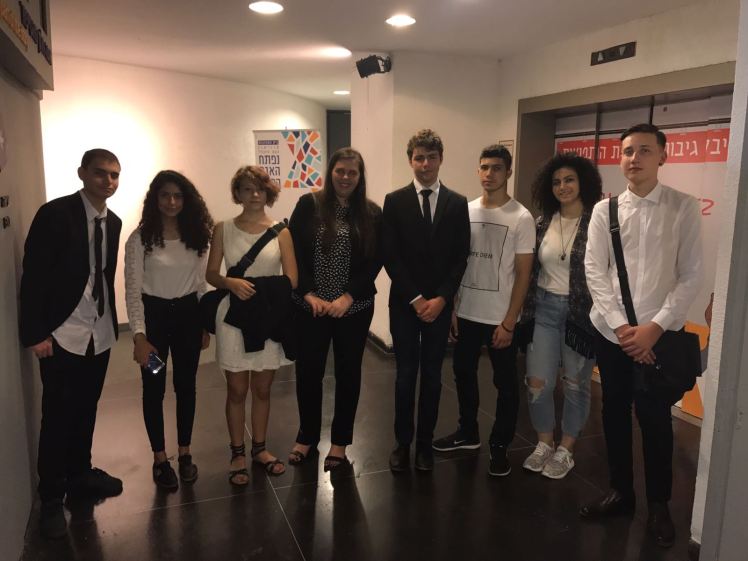
Or Moshe represents Debate for Peace at United Nations Day 2017 in Jerusalem

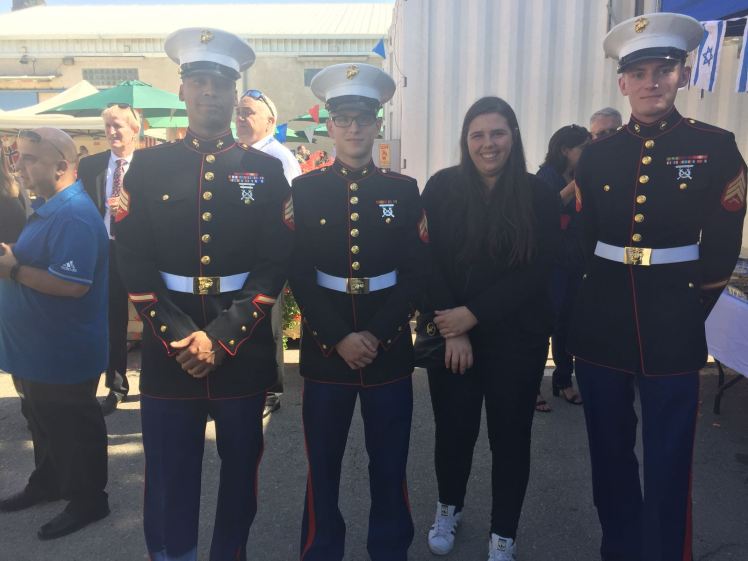
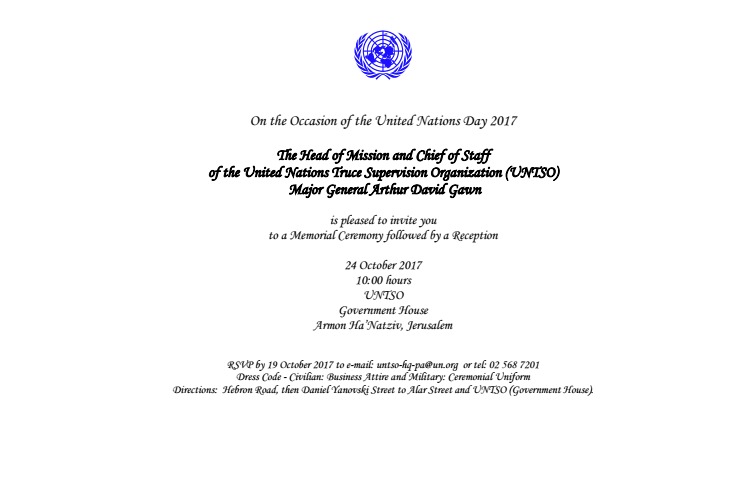
United Nations Day–on October 24th, marks the signing of the UN Charter in 1945. It has been recognized as a holiday for almost 70 years, since 1948. Yesterday, Ort Givatayim senior Or Moshe got to represent Debate for Peace at the 2017 United Nations Day celebration, at the UN building in Armon Hanatziv, Jerusalem. We are grateful to UNTSO for extending the invitation and helping to strengthen the UN-Model UN connection. Or was one of the youngest participants at the event, and she shares her thoughts on the occasion below.

WhatsApp Image 2017-10-10 at 5.13.23 PM

“Today, I had the opportunity to participate in an actual UN event and get a glimpse into the world of professionals. It has been an incredible experience. I have met and talked with people from UNTSO and the Israeli office for foreign affairs. I had the honor of participating in a UN memorial ceremony with soldiers from all over the world. I learned about different countries and cultures around the world and even tasted exotic food from the Caribbean.”

WhatsApp Image 2017-10-24 at 12.54.27 PM (1)
Flag Salute Ceremony, UN Day 2017, Jerusalem

Tomorrow’s Leaders Learn about Accountability from the UN Secretary General

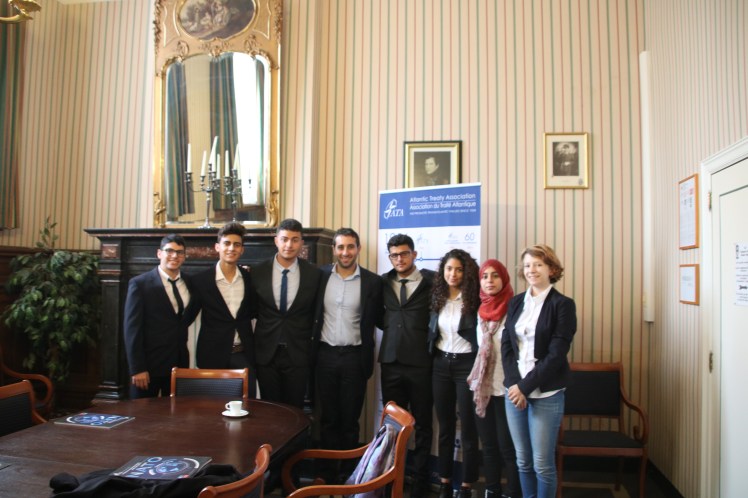
When UN Secretary General Antonio Guterres addressed a closed audience at the Diaspora Museum in Tel Aviv University last month, 8 Debate for Peace youth leaders had the opportunity to be part of the audience. We thank the staff of the UN Special Coordinator for the Middle East Peace Process (UNSCO) for helping to ensure that the leaders of the future get to hear from today’s global leaders.

WhatsApp Image 2017-09-20 at 07.52.18
Waiting to hear from the UN Secretary General


As their comments after the event show, students were appreciative of this special opportunity, and especially impressed by how the UN Secretary General addressed the difficult history of Jews in Portugal head-on, acknowledging travesties and tribulations, and taking responsibility for part iniquities.


Yuval (Ort Rabin in Gan Yavne)

Meeting the Secretary General was truly an experience. His speech was very interesting and meeting such an important diplomat is truly an honor. I’m very glad I had the opportunity to attend the event.

Sana (Al-Qasemi High School in Baqa al-Gharabiya)

The UNSG was very warm and thankful to be there, and I am very happy I got to be a part of something like this, something that doesn’t happen often. It was a great opportunity and a wonderful experience

Alon (Ben Gurion High School in Petah Tiqva)

The experience of hearing Mr. Guteress’s speech was very interesting. It was a huge honor for me to attend the speech of such an important person. I learned from the speech that Portugal had an unfortunate history with its own Jews.

Ben (Yachad High School in Modi’in)

It was such an interesting environment to be in, and it really puts you in perspective where you will you be if you’ll work hard enough. Hearing the Secretary General talking about problems relevant to this day and apologizing for his native country’s crimes against the Jewish community back in the 15th century was extremely moving.

Zohar (Wizo Hadasim High School in Even Yehuda)

The UN Secretary General spoke truthfully about his country [Portugal], about its mistakes during the Second World War and has apologized. It showed that he has taken responsibility of their past and that he truly strives to improve the situation.

Yafa  (Bashaer High School in Sakhnin)

It was an honor to meet the Secretary General of the United Nations. I felt a wonderful feeling: everything was perfect and exciting. It was an unforgettable experience that I would like to repeat again.

Gaining Renewed Energy from New Friends and New Experiences

UNSC
A visit to the UN Security Council Chamber

Hey everyone! I wanted to share with you my life-changing trip to the US this summer.

Following Debate for Peace MUN conferences, I was invited to the Jerusalem PeaceBuilders summer camp in Houston, Texas. In the beginning I had some doubts about the camp and the fact that I was going to be the only Israeli Jewish male in the camp, but I went anyway. I was wrong to doubt– the JPB camp was beyond my expectations!

WhatsApp Image 2017-08-18 at 23.32.42
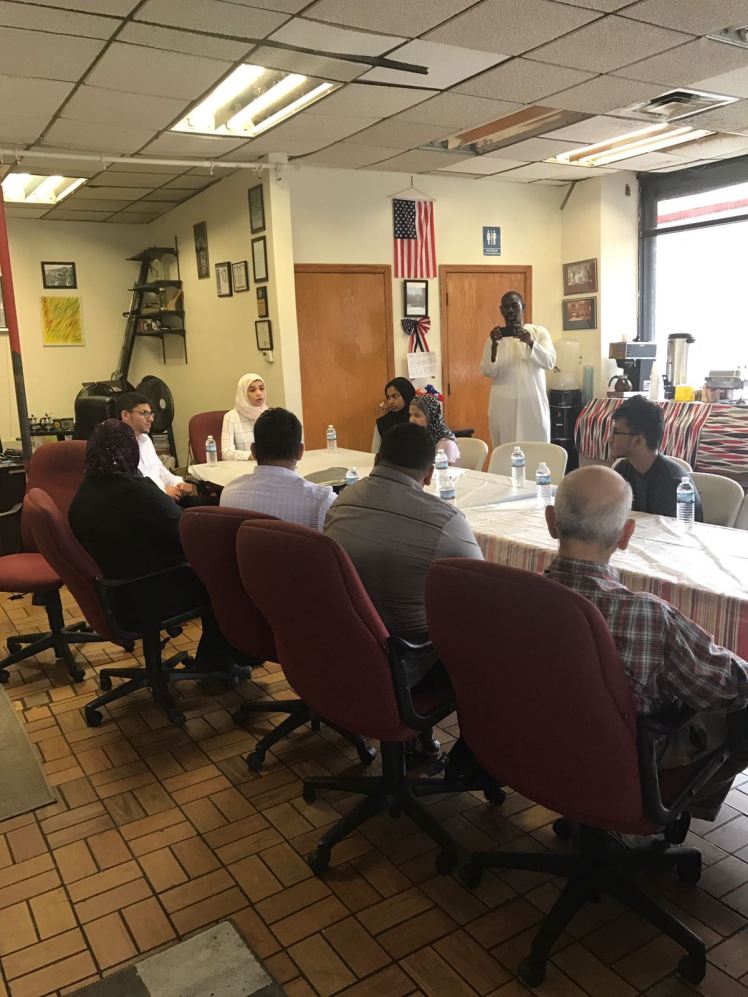
Speaking at a mosque in the Bronx

In this camp I got the unique opportunity to spend almost 2 weeks with youth in my age. I met so many new friends and we had so much fun together doing summer camp activities and peace-building dialogues. The meaning of the camp for me was creating these bonds between the religiously diverse participants and making us better interfaith citizens.

In our time at the JPB program I got to attend a Juma’a prayer in a mosque and a Communion service in a cathedral for my first time! It was so new for me and I’m glad I could observe it. We also went to a Reform Judaism synagogue, where we held a service in different way from what I’m used to, as an orthodox.

21055890_276690756148919_422204309660594278_o
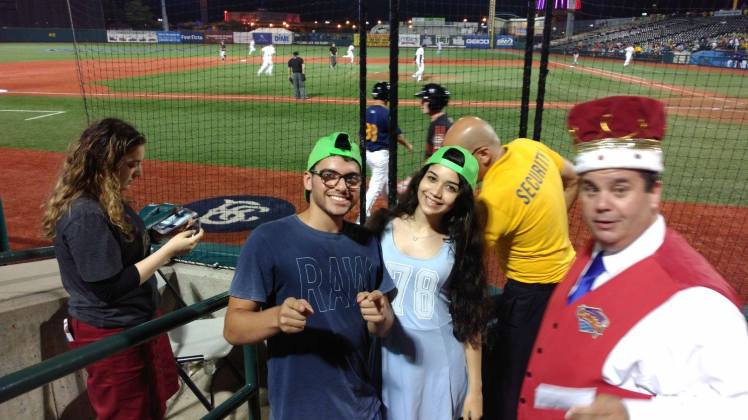
Preparing to go on-field at our first baseball game!

The second part of my trip was in NYC and NJ. Together with Debate for Peace director Steven Aiello and a fellow Muslim Arab student Khetam Kalash, we represented Debate for Peace and talked to fellow interfaith leaders in the metropolitan area of New York. I had so much joy spending time with people who care about a better, peaceful future. I feel as they brought me a new, stronger second wind to work harder for bringing people together, and creating more friendships between those close, yet so far, communities.

A Muslim Arab from Israel Preaches Peace at Mosques and Synagogues in NYC

IMG_0465
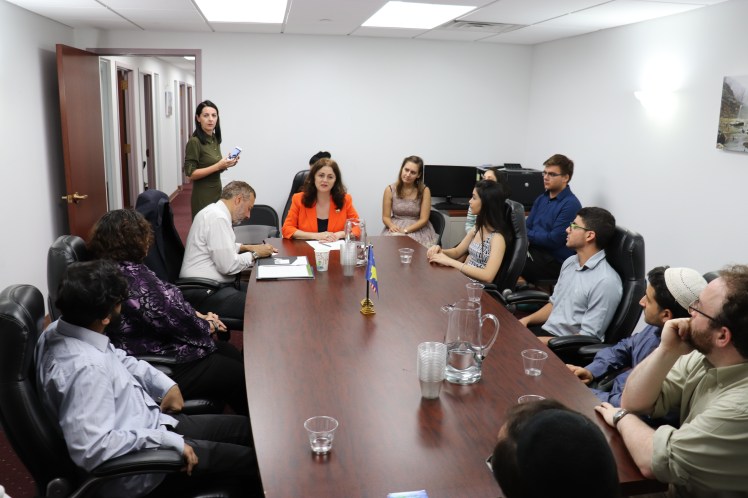
Interfaith Summit with the Ambassador of Kosovo

Khetam Kalash, 16, from Nahda High School in Kufr Kara, spent 2.5 weeks this summer at the Jerusalem Peace Builders camp in Houston followed by the Debate for Peace extension in NYC. These are her reflections from the trip:

I don’t know from where to start, it’s just too much to tell, but the most important: it’s unforgettable.

On the 2d of August, it all started.

My parents left me with the JPB (Jerusalem Peace Builders) participants in the airport after a lot of hugs and instructions; I’m leaving them for 3 weeks! And after 15 hours of flights, we finally arrived in Texas, USA to start the journey or you can call it a challenge too, for two weeks.

Now you’re probably wondering what is JPB? JPB is an American organization that picks all different (and unique) Muslim, Jewish, and Christian students from Israel and the US ages (14-18) and brings them together to discuss how things go in the Israeli-Palestinian conflict, how people see it, what’s the point of view for each one of us and how can we bring peace and live together in one country, or maybe two in the future!

We heard from an imam, a rabbi and a priest, we prayed together, we ate together, we slept together, we shared everything together, we had no hate for anyone, we were such a family! And yes, it was amazing and brought hope for each one of us that this is gonna happen! That we don’t have to hate each other because of political reasons that have no sense maybe, we’re all humans who bleed the same blood, we’re all equal! What made me strongly believe in this, once during the program we went to a church, the imam and the rabbi sang there like we’re all the same belonging to the same god, religions can’t divide us!

Dasha
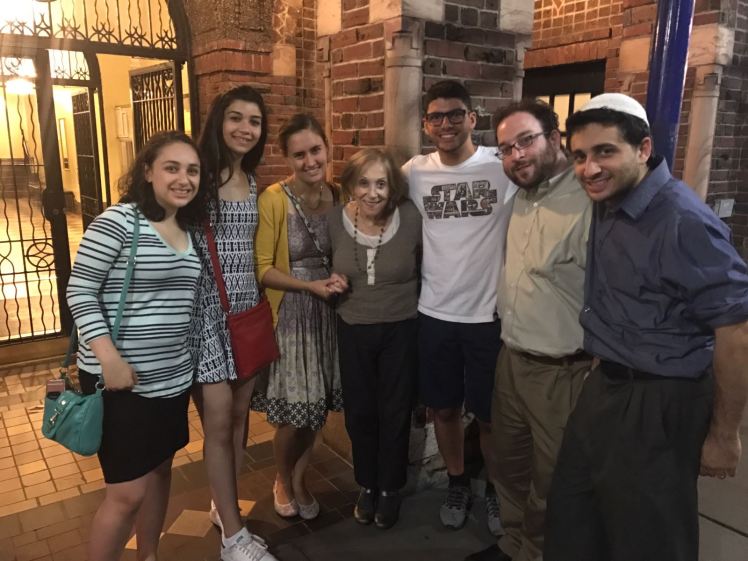
Meeting a Holocaust survivor friend in Manhattan

After these beautiful 2 weeks, me and Omri (a Jewish student my age) got to travel to New York to share and talk about a program we have in Israel called “Debate For Peace” for high school students (aged 15-18), which brings Arab and Jewish students together in different (Arab and Jewish) cities all around Israel through the school year, and sometimes in the summer vacation too! We debate and discuss different topics that usually students don’t think about or don’t have the chance to talk about it.

In this program we have a conference every 3 months on average, and each conference has a topic like religions/ peace/ refugees.. and it’s divided into committees (25 student for every committee). Each participant has a random country to represent in some topic, and should represent it well even if its policies don’t agree with our beliefs, and in the end we have a best and an outstanding delegate for each committee. But the main goal is not about winning and debating, it’s mainly about gathering Arab and Jewish students together, as well as improving our English (as a third language for Arabs and a second language for Jewish students) and raising our self confidence by challenging ourselves to stand up and speak.

20953679_276706716147323_1835802251016531059_n
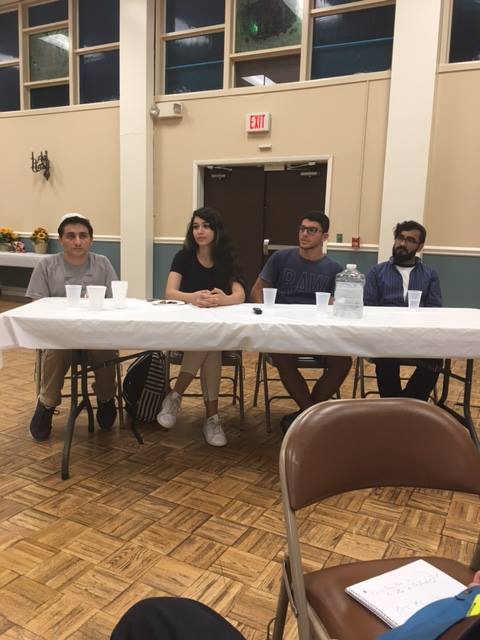
Speaking on a panel at a synagogue in New Jersey

So what did we do in New  York City for a week? We visited 2 mosques and 2 synagogues, the embassy of Kosovo, the Center of Jewish History, and did a lot of other interesting and fun things.

We got the chance to introduce our program (Debate for Peace) and talk a little about our experience in JPB, and as you would expect, we had a lot of support and a lot of questions about Israel and Palestine, and how Arabs, Muslims and Jewish people live together.

For me it was such an unforgettable experience that changed me in a good way, how to see and deal with things better, and how “physical age” can’t stop you from accomplishing “big things” or things that older people don’t have the courage to do. For instance, I was the first non-jewish Arab speaker in one synagogue in New York to come talk about peace, and I’m only 16! What you only have to do, is to believe in yourself and then you can achieve great things!”

Volunteering Event

On April the 21st, our group volunteered to help take care of kids in a kindergarten in south Tel-Aviv, as a way to strengthen the sense of community in a place where it is much needed,  as well as empowering the sense of team work and self worth.

Our group is constructed of about eleven 16-19 year old students who come from all over Israel, starting with Kufr Bara All the way to Gedera, and who come from different religious backgrounds. Here is some of the feedback we got from the kids:

“It was an amazing experience,
I really enjoyed it even though it was a little bit tiring. So happy that I got to meet the lovely children. Hope that we could do it again:)”

-Donia Daghash

“The other day was a great experience even though there were some challenges with people, I enjoyed having fun with the kids”

-Serena Bush

“I think it was a good experience to volunteer in tel aviv
But it was. Hot outside and we didnt have that much fun

-Lana Wattad


UNSC Crisis Committee: Iran-Israel

The Simulation

“Iran has continued its aggressive anti-Israel rhetoric, along with intercontinental ballistic missile tests. There have been little repercussions for its choices—as part of the nuclear deal agreed to through the UN, sanctions have been lifted, Iran’s economy is growing and Asian and European countries are trading with it. The hopes of some that a new US regime would take a more aggressive stance towards Iran failed once President Bernie Sanders came into office—his presidency has become even more willing to look the other way with Iran’s double-dealings. With more leeway and more resources, Iran has increased support for Hezbollah and Hamas, as well as continuing to strengthen its influence in Syria and Iraq.

Israel as well as Saudi Arabia and the Sunni Arab states have grown frustrated by Iran’s seeming ability to do whatever it wants, without any repercussions for its actions. On January 15th, Israel launches a comprehensive attack on Iranian military installations, including several underground research and development facilities. The attack involved flying over Jordanian and then Saudi airspace.”

This is the scenario that a dozen high school students found themselves in on Sunday, April 10th. Simulations of this nature are typically run by academics and policy experts, but as part of our Model UN program, we asked our most advanced students to represent a stacked version of the Security Council—one which included countries like Egypt, Iran, Israel, Lebanon, Saudi Arabia, Turkey and the Emirates, as well as Germany and the P-5 countries. In Model UN parlance this is called a “Crisis Committee”, and attempts to mirror real-life situations by introducing periodic “updates.” Delegates (aka students) must then respond dynamically to one another’s speeches and ideas, as well as the evolving circumstances. In keeping with our MUN program’s focus on Middle East-related topics, we chose to simulate a comprehensive Israeli airstrike. Delegates were informed that Israel had hit 13 targets, but that information about what precisely had been targeted was not yet available.


Opening Salvos

The Iranian delegate opened the conference by calling attention to the improvements that Iran had been making in the global economic order and calling the attacks not just an unjustified violation of national sovereignty, but harmful to international interests. That was hardly surprising however. It was Saudi Arabia that was the first country to change the internal dynamics, when it used its opening speech to declare its support for Israel, which it defended as having acted under threat from Iran. We had deliberately left the simulation instructions and information provided vague enough to allow delegates like the Saudi one to determine whether they were going to openly support one of the two sides, or maintain neutrality and condemn both sides.

China followed up the Saudi speech by in turn excoriating Israel for its attack on Iran. Israel spoke next and justified its attack as being in response to Iranian threats. Lebanon supported the Iranian position, again unsurprisingly, and referenced prior Israeli strikes on Iraq and Syria in an attempt to show a pattern of unilateral and unjustified attacks by Israel. Turkey brought up Israel’s possession of nuclear weapons as evidence that Israel was no more innocent in that area than Iran, However the American delegate followed that up by silencing Iran and its supporters by citing Iran’s launch of missiles with an explicit call to wipe out Israel, as the threat justifying Israel’s attack.


An Evolving Game

As promised, less than an hour into the simulation, delegates received their first “update.” They were informed that although information on the Israeli airstrikes was still limited, it had now been confirmed that at one of the sites, 200 Iranian civilians—primarily factory workers, had been killed, and that what was believed to be a fortified research facility was actually a bicycle factory, located underground, presumably as a decoy target by the Iranians in the event of just such an attack.

After receiving some time to process this new information, delegates continued discussing among one another before returning to the formal debate, where Iran and its supporters attempted to use this information to pressure Israel and censure its actions. Israel did not back down however, nor did many delegates seem swayed, as they stuck with the argument that it was Iran’s fault for deliberately hiding a bicycle factory in underground bunkers and putting civilians at risk of harm (for its part, Iran called this response “Israeli propaganda”).

A later update told delegates that there had been a double terror attack perpetrated on Israeli Embassies in Argentina (a repeat of the 1992 attack) and Mexico, with the latter attack leaving an Israeli diplomat hospitalized and 8 local workers killed between the two attacks. The attacks were believed to have been perpetrated by Hezbollah-linked agents.

Although changing the focus of the discussion, neither update significantly set the delegates off-topic, and they maintained focus on the primarily plot-line—the Iranian-Israeli nuclear issue, and what should be done to prevent future violence from occurring.


The Suggestions

France had suggested improved supervision of Iran’s nuclear program (a consensus of most of the countries and indeed of the simulation itself being that there was significant mistrust of the status quo supervision). There was soon a working paper in circulation which called for sending a UN supervising force to be stationed in both Iran and Israel, with Russia overseeing the Iranian mission and the US overseeing the Israeli mission. This suggestion was supported by 9 countries, including France, Russia, the US and Israel.

An alternative working paper called for sanctioning Israel for its actions, monitoring Israel’s nuclear plants (arguing that Iran was already under supervision), and sending a UN team to monitor Israeli military activities and prevent future outbreaks of violence. This initiative was put forth by China, Iran and Lebanon.


Compromise and Conclusion

Given that 9 of the 12 delegates supported the more neutral language of the first working paper, it became a question of convincing China, which could veto any draft resolution, to lend its support. This was eventually achieved by a bold—albeit vague, call for Israel to announce its nuclear activities. China accepted this compromise, and the resolution passed by overwhelming majority, bringing the committee to an end. The delegates of Israel and Iran received commendation from their peers as the Best and Outstanding Delegates respectively.


Takeaways

The simulation showed what might happen if Israel felt pushed to the brink by US and European rapprochement with Iran, but on the other hand, received tacit support from Saudi Arabia and other key Sunni states. The proceedings indicated that given the chance, many of those countries would take the opportunity to call for a deal with more robust supervision on Iran (and for the Sunni states, greater supervision of Israel in the name of neutrality was an added bonus). Although it’s debatable whether and which Arab states might publicly declare their support for Israel in this hypothetical, the mistrust of the deal itself could lead to an attempt to rewrite its terms, as happened in our simulation.

Celebrating Cultural Diversity While Remaining Unified Through Olympic Values

Originally posted on August 8, 2012, for the Berkley Center for Religion, Peace and World Affairs. Read the original post in full here.

In the twenty-first century, internet and social media have brought globalization to a new level. Information technology and other advances bring people together and offer hope for a brighter future.
In our world, this presents a dual challenge—respecting the ‘other’ with whom we are brought into contact in an increasingly frequent and salient fashion, and protecting our own cultural, ethnic, national, and religious identities in light of constant exposure to diversity. An additional challenge, which many of us may experience in some form, is that of self-identity—am I a Jew, an Italian, an Israeli, an American?

These questions can lead to unfortunate outcomes on the micro and macro levels. I believe that Olympic values in 2012 may offer the optimal answer. Through the Olympics, the world’s nations compete to bring medals home. It is the ultimate honor to wear one’s national colors while competing against others representing their own heritages. Yet at the same time, there is a great source of respect upheld. Ironically, Olympians competing individually rarely get into personal conflicts while professional athletes competing in team sports are wont to. This speaks to integrity, honor, and respect. Athletes standing alone at the Olympics bear the weight of their nations. Through the respect shown to one another, they transmit a message of mutual respect for the various nations.

For those of us viewing Olympic Games, it is impossible to ignore our similarities—as well as our differences. Certain nations will win many awards; others will win fewer. Some long for the winter Olympics; yet others shine in the summer Olympics. I will root for the American team as an American, the Israeli team as a Jew who has lived in Israel, and for team Italia in tribute to my Italian heritage. But I will also be happy when the Egyptian, Japanese, Swiss, or Thai team wins a medal. This is out of respect for the cultures and nations which they embody, amplified by the fact that I have friends from each of these countries. A few decades ago this would have been unusual; today it is the norm.

This is the powerful key that Olympic values offer. Through respect for diversity we can maintain our own unique qualities while learning from the successes of others. We can be multicultural while still maintaining multiple cultures. As technology brings us closer we must balance cultural differences with integration of different cultures—all the while maintaining our personal identities. The Olympics, with its origins in ancient Greece, can teach us all how to build a better future, so that in another two millennia, regardless of what globalization may bring, we can still see the torch lit and the flags raised as each country and nation hopes to bring home a medal.

Originally posted on August 8, 2012, for the Berkley Center for Religion, Peace and World Affairs. Read the original post in full here.

The TIKVAMUN Debate- Hope for Our Future

Originally posted on the TOI blog on March 8, 2012. To read the full post, click here.

50 Jewish and Muslim Arab high school students crowd into an auditorium to debate the issue of Palestinian statehood. A Jewish student rises to speak on behalf of Palestine, his Arab partner at his side. An Arab girl representing Israel argues passionately against unilateral statehood; her kippa-clad partner waiting for his turn to speak. After two hours of intense debating, the committee votes on the motion to create a Palestinian state and by a two-thirds majority, the vote passes. The auditorium erupts in applause.

This is not a joke, or a dream, but a synopsis of what transpired on this past Monday evening (March 5th) in Petah Tiqva. During this event, students from AlQassemi college in Baqa, Qschool in Tira, and the Young Ambassadors school in Petah Tiqva, joined together for what is surely one of the most ambitious, exciting, and promising events in a region with a history of unsuccessful conflict resolution and failed mediation attempts.

The name chosen for the debate, TIKVAMUN, symbolizes its significance. Tikva means hope in Hebrew. These students, most 14-16 years of age, are indeed a source of great hope for creating a better future. Coming from different communities and religions from within Israel, each brought his or her own opinion and perspective to the auditorium in Petah Tiqva. Yet asked to take their assigned country’s position, each complied willingly and performed admirably. Placed with a teammate whom they had only just met, and with a very different point of view, they meshed immediately, and worked together as a team to do their best to represent their assigned point of view.

The project had numerous goals: we wanted to train the students, young leaders and top students from their respective communities, to learn how to argue from different perspectives, as well as giving them a chance to strengthen their ability and confidence to speak in public and debate in English, their second, third or fourth language.

In addition, bringing students together from such different worlds, living so close to one another, was of utmost importance to me personally. Israel faces many different challenges, internal and external. Even were the two various issues completely divorced from one another, the domestic issues facing Israel would still be of paramount importance, as they affect each and every member of Israeli society, if not directly then indirectly. In this I see a great need for further integration of the Jewish and Arab societies. Within ‘mixed cities’ this is somewhat less problematic, although far from perfect. However for an Arab student from Tira, or a Jewish student from Petah Tiqva, the exposure to peers from the other community is usually limited and impersonal. Yet if we are raising our children to be future leaders, in addition to learning of the various challenges which face Israel from without, they must be well in-tune with the various social issues to be dealt with internally, and well-acquainted with all of the sectors of Israeli society. Whether as a leader in Baqa, Tira, or Petah Tiqva, regardless of the students’ personal aspirations, the friendship of those from other communities as well as the ability to see things from opposing perspectives, may prove just as valuable as the abilities to debate, to speak in front of a crowd, or to converse freely in English.

For all of these reasons, I find the name TIKVAMUN to perfectly apt to describe the situation. Israeli and Palestinian leadership has been ineffective at agreeing on the necessary details to create a legally-recognized, politically sovereign Palestinian state. By most accounts an agreement could be achieved fairly easily; most issues could be resolved speedily and in fact many important concessions and compromises have already been offered. In recent years there is a perceived lack of will on both sides. The respective governments seem more bent on pandering to an American and international audience than working together to create a better future for themselves. Neither sides’ leadership seems to have bothered to see things from one another’s perspective. That such inability would lead to a failure in negotiations seems obvious.

Having a young core of leaders who can and will be dedicated to mutual respect, understanding and friendship is essential. They need not like one another, though it is certainly preferable. They need not agree with one another; to expect that would doom our efforts from the outset. They must simply recognize that each is an important member of society, representing a unique and valuable viewpoint, every one of which should be heard and considered. Mutual respect can lead to agreements, compromises and partnerships in which ultimately everyone (sans political extremists) stands to gain.

The part which I enjoyed the most of all began in the very beginning of the debate. When we called our first speaker to the podium, I expected one of the teammates to rise up and come to the front of the room. This is how it is generally done in more experienced MUNs in any case; where multiple delegates are present, whoever speaks will come to the podium. However in this case as soon as the speaker left his seat, his partner rose to join him as well. This sequence was the repeated by just about every group we had. Country after country, delegate after delegate, the students stood together on the stage, one who had chosen to speak accompanied by his or her partner. This level of spontaneous support, really summarizes the success of the evening to me. The natural feeling of loyalty towards one another, and empathy to the difficulty of standing alone at a podium in front of dozens of people, brought each speaker’s partner to join them in a silent gesture of support.

Coordinating, participating in, and witnessing this event has given me much hope in our future. These young leaders have exhibited characteristics and abilities which, had many of our leaders been endowed with, I can only believe would have changed the past  and present considerably. While every one of these students is truly special, it is safe to assume that most students, given such opportunities, would stand to benefit from such an experience, and I hope that each of our participants will share what they have acquired with their friends, and that this can be the first of many such endeavors. Our future is bright, and hopeful, when we can look forward to prospective leadership from the kind of leaders as we saw in Petah Tiqva on Monday night.

Originally posted on the TOI blog on March 8, 2012. To read the full post, click here.

How to Represent Saudi Arabia: Lessons Our Youth Can Teach Our Leaders

Originally posted on the TOI blog on February 26, 2012. To read the full post, click here.

One of the things which I have found most challenging while teaching high school students about topics like a UN vote on Palestinian statehood, has been getting the students to see other viewpoints. Thus I was very excited when told that a group of my Jewish students from Petah Tiqva would be representing Saudi Arabia at the TIMEMUN in Even Yehuda. This was the perfect opportunity to put what we had discussed in the classroom into practice.

Certainly, this was true. While we did not win any awards, my students worked hard to understand what their country’s position would be on issues ranging from renewable energy to reforming the UN member state application process to dealing with Iran on the issue of nuclear weapons, to freedom of religious expression. I am proud of their efforts to truly represent their assigned country’s interests.


However where I was most proud of my students, and most pleased with their performance, was with some of the discussions that they had back at our hotel. Shortly after dinner the first night, we moved to the lobby to begin preparing for the next day’s events. As I worked on my own papers and helped a few students prepare, I witnessed some of our delegation beginning a conversation with members of an Arab school from Haifa. Before long the conversation had turned political; an intense conversation ensued which from the snippets I caught seemed to span from British Mandate Palestine to contemporary Israel. Initially I was slightly concerned that the conversation matter might be too difficult for this forum. In the end the teacher of the other group and I had to drag the students away from one another—because they would have happily continued their conversations with one another all night and no one would have gotten any sleep. The next two days saw students from our two groups sitting next to one another on the buses, and during mealtimes. Their impassioned views had only brought them together, not pushed them apart.

It is hard for the most experienced of debaters to argue about the topics most sensitive to them. In an otherwise excellent debate on the Palestinian statehood vote which I have sent to all of my students to watch, there are inevitably points during the debate when different members, accomplished diplomats with a long list of credentials, lose their decorum and begin trying to yell out, cut one another off, and generally do all of the things which I discourage my students from doing. Suffice it to say that I do not believe they all left the room the best of friends. Yet my students and their peers have shown me that it is indeed possible to have such a debate while maintaining respect, and love, for those who hold differing viewpoints.

What I have seen from my students in the classroom, and in Even Yehuda, is extremely heartening. It is why I believe strongly in a grass-roots solution to the Israeli-Palestinian conflict. High level officials and leaders have shown their inability to listen, to hear one another, and an overall failure to understand the other’s viewpoint which will inevitably doom negotiations. Whether you agree with the perspective of the other side or not, you cannot negotiate or debate without at least listening to, and trying to understand the other side. This is something which I have been trying to teach my students, and I am happy to see that they seem to get it much more than your average government leader.

Originally posted on the TOI blog on February 26, 2012. To read the full post, click here.

Freedom of Expression in a Global Age

Originally posted on the TOI blog on February 12, 2012. To read the full post, click here.

For more than a month now my fellow MUN teammates and I have been working with two groups of high school students, teaching about international diplomacy, debate skills, and how to express themselves and represent countries. One group is comprised of Jewish students who wish to represent Israel abroad. The second is an Israeli Arab group of students who come after school to improve their English.

Understandably, the two groups of students have shown to have very different perspectives, and with both groups we experienced challenges initially when trying to see other perspectives on such emotionally and politically divisive issues as a UN vote to create a Palestinian state. Yet one very important lesson that I have learned from my students is that the ability to understand other perspectives, even those we may ultimately disagree with, is something that any young student can tap into, simply by making the effort. Both groups of students showed me that they were very capable within a matter of minutes of being put to the challenge.

To me that is the ultimate benefit of Model UN conferences, and the ultimate challenge of international diplomacy and conflict resolution. The first step must be the understanding that there is always another side to the story; there will always be different perspectives, including and perhaps especially those with which we may disagree. This is a lesson that I have learned from my students, and it is something that would have been lost from the conference if not for the wonderful ability for virtual communication that social media offers. I believe that the skill to see other views is in fact an ability that everyone is capable of inherently, and that social media amongst other aspects of globalization offers a huge opportunity in this regard.

Ultimately freedom of speech and expression are important rights—we should protect these rights, but we should also utilize them to learn from others.

To read the full post, including reflections from an MUN trip in Dubai, click here.